

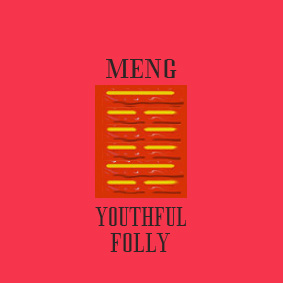
4. Meng; Youthful Folly Above; Ken, Keeping still, Mountain Below; K'an, The Abysmal, Water
|
21st Century | Comparison |
| Experience tells us that if our mistakes don't kill us we learn.
In a time when precedents are wanting keen observation and a willingness
to accept the novel will be of assistance. After a certain age you cannot
afford to make the mistakes of a child. Tolerate a fool but do not become
one.
Nothing wrong with one mistake. Repeat the mistake and misfortune follows. There is a slatternly streak in all of us. We want without knowing what we want. Ignorance opens us to manipulation and exploitation. We want and like whores we do for the money. Thinking objects are the goal is misleading. All is preparation for the crossing. |
Below are the interpretations of a) Legge, b) Willhelm, c) Riefler, d) Crowley
a) The dispelling of ignorance. It will be advantageous to use punishment (for that purpose), and to remove the shackles (from the mind). But going on in that way (of punishment) will give occasion for regret.
b) To make a fool develop It furthers one to apply discipline. The fetters should be removed. To go on in this way brings humiliation.
c) The ignorant man must be dealt with severely and encouraged to open his mind if his ignorance is to be dispelled. Some guilt if you are too firm for too long.
d) Correct him once to free; twice let him go!
e) Ignorance is not dispelled by pedantry and harshness. But by being correct, compassionate and firm.
a) Exercising forbearance with the ignorant, in which there will be good fortune; and admitting (even) the goodness of women, which will also be fortunate. (he may be described also as) a son able to (sustain the burden of) his family.
b) To bear with fools in kindliness brings good fortune. To know how to take women brings good fortune. The son is capable of taking charge of the household.
c) The man puts up with the ignorant and has a way with the women but he can fill his father's shoes when the time comes. Auspicious.
d) Treat fools and women kindly; they have their uses.
e) Due his patrimony when he has learned kindness to fools, and women.
a) That one should not marry a woman whose emblem it might be, for that, when she sees a man of wealth, she will not keep her person from him, and in no wise will advantage come from her.
b) Take not a maiden who, when she sees a man of bronze, Loses possession of herself. Nothing furthers.
c) The girl embraces the marble fawn mistaking it for the real one. No success.
d) Wed not loose women; only That they know.
e) Marry one beguiled by wealth and you've married a harlot.
a) bound in chains of ignorance. There will be occasion for regret.
b) Entangled folly brings humiliation
c) Enchained in ignorance. Guilt.
d) Chains bind the ignorant, and sorrows flow.
e) A chain of ignorant acts binds one to a sorrowful outcome.
a) A simple lad without experience. There will be good fortune.
b) Childlike folly brings good fortune.
c) The barefoot boy. Auspicious
d) Yet - the Great Fool! Simplicity's good glow!
e) Innocent mistakes may have happy endings.
a) Smiting the ignorant (youth). But no advantage would come from doing him injury. Advantage would come from warding off injury from him.
b) In punishing folly It does not further one To commit transgressions. The only thing that furthers Is to prevent transgressions.
c) The man whips the barefoot boy. Ominous if you take advantage of the ignorant. Auspicious if you protect the ignorant.
d) Protect the ignorant from all abuses!
e) Punishing insouciance is folly. Better to inform and protect.