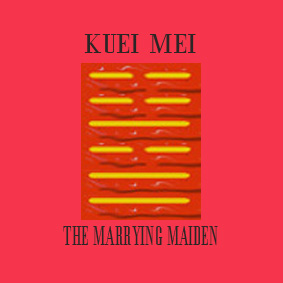

54. Kuei Mei; The marrying maiden Above; Chen the Arousing thunder Below; Tui the Joyous lake |
21st Century |
Comparisons |
| Tradition required marriages be mostly for dynastic
purposes among the upper classes. A young wife introduced in to a wealthy
household was in peril of earning the first wife's antagonism if she did
not follow a strict protocol. This hexagram is not about concubinage but
about understanding forms and how to fit into them. About how to be
effective even when one is relatively insignificant.
Once a matrimonial commitment is begun loyalty is its fountain head. One must not settle for just anything. Panic about time might lead one into foolish arrangements. This is to be eschewed in favour of a pious commitment to the right partnership which came along because of patience. As to what is right is determined by factors like ethics. However once entered upon it must be taken seriously with all the trimmings otherwise it does not stand a chance in this world of temptations. The hexagram is not about self abnegation but about self enhancement through association with commitment.
|
Below are the comparative interpretations of a) Legge, b) Willhelm, c) Riefler, d) Crowley
a) the younger sister married off in a position ancillary to the real wife. (It suggest the idea of) a person lame on one leg who yet manages to tramp along. Going forward will be fortunate.
b) The marrying maiden as a concubine. A lame man who is able to tread. Undertaking bring good fortune.
c) The betrothed is not the first either in time or preference. The lame manage to get along. Auspicious for an advance.
d) Go it, you cripples! I'll hold your crutches.
a) shows her blind of one eye, and yet able to see. There will be advantage in her maintaining the firm correctness of a solitary widow.
b) A one eyed man who is able to see. The perseverance of a solitary man furthers.
c) The betrothed is blind in one eye but she can still see. The course she keeps to is like that of a widow.
d) Blind of one eye? Be as chaste as a duchess!
a) the younger sister who was to be married off in a mean position. She returns and accepts an ancillary position.
b) The marrying maiden as a slave. She marries as a concubine.
c) The marriage does not please the maiden. She returns home and accepts her former place.
d) Now, younger sister, there's scrubbing to do;
a) the younger sister who was to be married off protracting the time. She may be late in being married, but the time will come.
b) The marrying maiden draws out the allotted time. A late marriage comes in due course.
c) The maiden procrastinates. Sooner or later she will marry.
d) Better postpone matrimonial clutches!
a) reminds us of the marrying of the younger sister of (king) Ti Yi, when the sleeves of her the princess were not equal to those of the (still) younger sister who accompanied her in an inferior capacity. (The case suggests the thought of) the moon almost full. There will be good fortune.
b) The sovereign I gave his daughter in marriage. The embroidered garments of the princess Were not as gorgeous As those of the serving maid. The moon that is nearly full Brings good fortune.
c) The maiden is not as beautiful as the bridesmaids. The moon is not yet full. Auspicious.
d) Think of Ti Yi and his sisters anew!
a) the young lady bearing the basket, but without anything in it, and the gentleman slaughtering the sheep, but without blood flowing from it. There will be no advantage in any way.
b) The woman holds the basket, but there are no fruits in it. The man stabs the sheep, but no blood flows. Nothing that acts to further.
c) The maiden is barren. The groom's knife draws no blood from the sheep. No improvement.
d) No meat on the chops, and no beans in the stew! s